
Doctor Supplement Collaboration Checklist: 10 Red Flags to Check Before You Say YES
Thinking about accepting a supplement, nutraceutical, or wellness brand collaboration?
For a doctor, a supplement collaboration is not simply another influencer or social media opportunity.
When your name, photograph, medical qualification, or professional credibility is connected to a commercial health product, the communication deserves careful review.
This is particularly important when the collaboration includes a product recommendation, medical claim, paid promotion, or public endorsement.
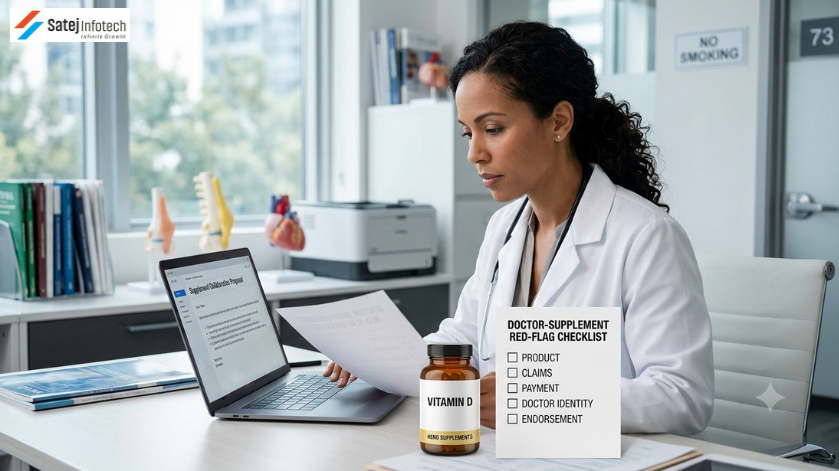
Before you accept a supplement collaboration, use this practical 10-point checklist.
1. What Exactly Is the Product?
Start by identifying what the brand is actually selling.
Is it a:
☐ Supplement
☐ Nutraceutical
☐ Wellness product
☐ Health-related commercial product
Don’t assume that calling something a “supplement” makes the endorsement issue disappear.
Look at the actual product, the claims being made about it, and the role you are being asked to play.
Ask:
“What exactly am I being asked to promote?”
2. Am I Publicly Endorsing the Product?
Look carefully at the proposed script, caption and visuals.
Watch for statements such as:
❌ “I recommend this supplement.”
❌ “This is the supplement I trust.”
❌ “I prescribe/recommend this to my patients.”
❌ “Every woman should take this.”
The applicable professional-conduct framework specifically addresses public endorsement of a drug or product of the industry by a medical practitioner.
So don’t focus only on whether the product is labelled a supplement.
Also ask:
“Am I being presented as a doctor who personally recommends this particular product?”
For a broader review of public product endorsements, see our Doctor Product Endorsement Red-Flag Checklist.
3. Is My Professional Identity Being Used?
Look at how the brand wants to present you.
☐ Is your name being used?
☐ Is your photograph being used?
☐ Are you being introduced as a doctor?
☐ Are your qualifications being displayed?
☐ Are you appearing in the brand’s advertisement?
Now ask:
“Is the brand using my medical qualification to make this product more credible?”
If your professional identity is central to why the audience should trust the product, the collaboration deserves careful consideration.
You can also review the NMC-Safe Posting Checklist before publishing professional or promotional content.
4. Am I Being Paid or Receiving a Benefit?
Understand the commercial arrangement before agreeing.
Are you receiving:
- Payment?
- Free products?
- Affiliate commission?
- Sponsorship?
- Another commercial benefit?
A commercial relationship is an important reason to review the collaboration carefully.
Ask:
“What am I receiving, and what is the brand receiving from my professional credibility?”
Don’t agree to a collaboration without understanding the arrangement.
If the collaboration involves an influencer, sponsored content or third-party promotion, also review the Doctor Influencer Collaboration Checklist.
5. Am I Making a Medical Claim?
This is one of the biggest red flags.
Look for claims such as:
❌ “Treats PCOS.”
❌ “Prevents hair loss.”
❌ “Cures deficiency permanently.”
❌ “Guaranteed results.”
❌ “Works for everyone.”
These statements go beyond simply describing a supplement.
They can communicate treatment, prevention, cure, or outcome claims.
Ask:
“Can I personally stand behind this medical claim?”
Don’t allow a brand’s marketing team to turn your professional communication into an unsupported medical claim.
For a broader framework covering treatment, prevention, cure, guarantee and other promotional claims, see the Doctor Marketing Claims Checklist.
6. Am I Recommending the Product to Patients or the Public?
There is an important distinction between education and endorsement.
Educational
“Here is some general information about nutritional supplementation.”
Endorsement
“I recommend Brand X supplement to my patients.”
The second statement specifically associates your medical authority with a commercial product.
That requires particular caution.
Before approving the content, ask:
Am I explaining supplementation generally, or recommending this particular brand?
This issue also connects directly with our Doctor Product Endorsement Red-Flag Checklist, which covers product-specific recommendations and public endorsements.
7. Is the Content Actually Educational?
A brand collaboration may be presented as “educational.”
But don’t rely only on the label.
Ask:
☐ Is the primary purpose genuinely to educate?
OR
☐ Is the educational information mainly being used to sell a particular product?
Look at the complete communication:
Educational Information
Product Mention
Doctor’s Authority
Product Recommendation
CTA
The overall context matters.
Calling a post “educational” doesn’t automatically make the commercial aspect disappear.
Review the Doctor Marketing Claims Checklist when educational content also contains product claims or promotional statements.
8. Where Will the Promotion Appear?
Find out exactly where the content will be published.
☐ My Instagram
☐ Brand’s social media
☐ Influencer’s account
☐ Brand website
☐ Paid advertisement
☐ Other digital platforms
Don’t assume that moving the content to another account changes the nature of your involvement.
If your:
Name + Photograph + Medical Qualification + Professional Authority
are being used to promote the product, review the collaboration carefully regardless of where the content appears.
If an influencer or another third party is distributing the promotion, see our Doctor Influencer Collaboration Checklist.
9. Has the Brand Written the Claims for Me?
This is something doctors should take seriously.
A brand may provide you with a ready-made script.
Before recording it, ask:
☐ Have I independently reviewed every medical claim?
☐ Do I personally stand behind the wording?
☐ Is the information factual and supportable?
☐ Am I comfortable having my professional name associated with the content?
Don’t let a brand’s marketing team put words in your mouth.
If you’re the doctor appearing in the content, your professional identity is attached to the message.
Review it before you record.
Before publishing, you can also compare the content against the NMC-Safe Posting Checklist.
10. Ask the Final Question
Before saying YES, ask yourself:
“Am I educating people about supplementation, or am I using my medical credibility to sell this particular product?”
If the answer is the second:
Pause and review the collaboration carefully.
Look at:
Product
↓
Claims
↓
Recommendation
↓
Payment / Benefit
↓
Doctor’s Identity
↓
Platform
↓
Overall Message
Don’t let the payment, free products, follower reach, or popularity of the brand become the only factors in your decision.
The Quick Supplement Red-Flag Test
Before accepting a supplement collaboration, look for this combination:
🔴 STOP & REVIEW
Doctor + Supplement Brand + Public Endorsement
Especially when combined with:
Paid Collaboration
Doctor’s Identity
Product Recommendation
Medical Claims
If these elements are present together, pause before accepting the collaboration.
For the broader product-endorsement framework, see the Doctor Product Endorsement Red-Flag Checklist.
🟢 A Safer Direction
Where appropriate, keep professional communication focused on:
General Education
↓
Evidence-Based Information
↓
Patient Awareness
↓
No Product Endorsement
↓
No Exaggerated Claims
The distinction is important.
The goal isn’t to say that every discussion about supplementation is automatically inappropriate.
The question is how the doctor is involved and how the commercial product is being presented.
Being a doctor gives your recommendation additional credibility.
That’s exactly why commercial supplement collaborations deserve careful consideration.
Before accepting one, ask:
What is the product?
Am I endorsing it?
Is my medical identity being used?
Am I being paid or receiving a benefit?
Am I making a medical claim?
Am I recommending the product to patients or the public?
And most importantly:
“Am I educating people about supplementation—or using my medical credibility to sell this particular product?”
If it’s the second, pause before you publish.
Want More Practical Marketing Guidance for Doctors?
Building a doctor’s online presence requires more than increasing followers and reach.
For a broader checklist covering claims, patient content, advertising, collaborations and professional digital communication, see the Doctor’s NMC-Safe Digital Marketing Checklist.
Your content, claims, collaborations, patient communication and professional identity all need to work together.
At Doctor Growth System by Satej Infotech, we help doctors build their digital presence through:
- Social Media Strategy
- Doctor Branding
- Content Planning
- Local SEO
- Google Business Profile Optimization
- Healthcare Website Development
- Patient-focused Digital Marketing
Want a FREE 15 Min Marketing Audit for Your Practice?
Click the WhatsApp button below. 💬 Message “FREE 15 min Marketing Audit” on WhatsApp
Frequently Asked Questions
Doctors should carefully review supplement collaborations against the latest applicable professional-conduct requirements. Particular caution is appropriate when the doctor is publicly endorsing a specific commercial product or using their professional identity to promote it.
A general discussion about nutrition or supplementation is different from publicly recommending a specific commercial brand. Doctors should carefully consider the nature and purpose of the communication before associating their professional identity with a product recommendation.
A paid collaboration involving a doctor's professional identity should be carefully reviewed. Consider what is being promoted, what claims are being made, how the doctor is presented, and what commercial benefit is involved.
Receiving free products can form part of a commercial collaboration. Doctors should understand the arrangement and carefully consider whether their professional credibility is being used to endorse the product.
Treatment or prevention claims about a commercial supplement should not be made casually. Doctors should ensure that any medical claims are appropriate, factual and supportable and review the collaboration against applicable professional requirements.
Doctors should carefully review the complete video, including the script, medical claims, product recommendation, captions and CTA. A brand-provided script should not be accepted without the doctor independently reviewing the claims.
Calling a collaboration "educational" does not by itself determine how the content should be treated. Consider whether the primary purpose is genuine education or whether the educational information is being used to sell a specific commercial product.
Moving the content to a brand's or influencer's account does not automatically remove the professional considerations if the doctor's name, photograph, qualifications or professional identity is being used in the promotion.