Do Doctors Need to Delete Old Instagram Posts After the New NMC Guidelines
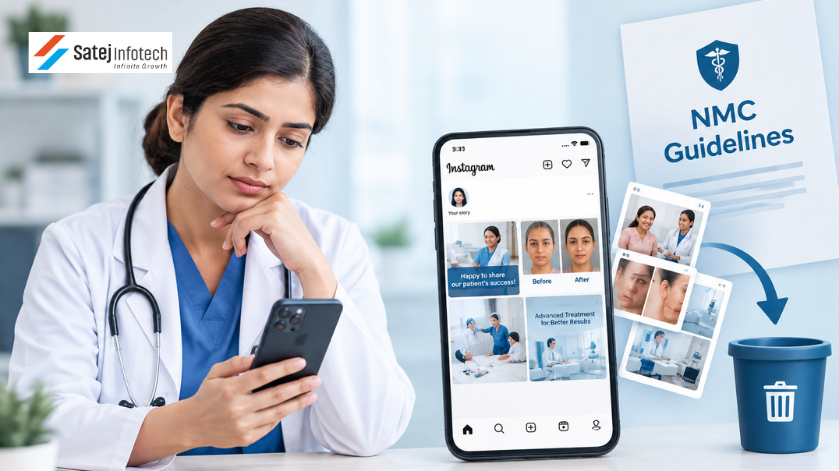
Doctor, have you been wondering what to do with the Instagram posts you published before 6 October 2026? Perhaps you've shared patient success stories, before-and-after photos, treatment results or posts promoting your clinic. Now you're wondering whether you need to…
On this page
Doctor, have you been wondering what to do with the Instagram posts you published before 6 October 2026?
Perhaps you’ve shared patient success stories, before-and-after photos, treatment results or posts promoting your clinic. Now you’re wondering whether you need to delete everything and start again.
The answer is: don’t panic, but don’t assume your old posts are automatically exempt either.
Let’s understand what the earlier rules said, what the new guidelines address and how you can review your existing content.
1. Were these restrictions already in place?
Yes. Some restrictions on medical advertising and self-promotion existed before October 2026.
The Indian Medical Council (Professional Conduct, Etiquette and Ethics) Regulations, 2002, as amended up to 8 October 2016, contained provisions relevant to doctors’ professional publicity.
- Regulation 6.1.1: Restricted advertising, patient solicitation, self-promotional publicity and boasting about cases, operations, cures or remedies.
- Regulation 2.2: Addressed patient confidentiality.
- Regulation 6.1.2: Restricted certain forms of self-advertisement involving photographs and publicity material on letterheads and clinic signboards.
These provisions did not use every term commonly associated with today’s social media. However, some promotional practices could already have raised ethical concerns.
For example, a doctor posting a patient’s treatment success story to promote their own practice could raise concerns about self-promotion and boasting about outcomes.
The new guidelines make the expectations around digital communication, testimonials, treatment results and promotional content more explicit.
2. What do the 6 October 2026 guidelines say about old posts?
The new guidelines state that they come into force upon publication. However, the published document does not contain a blanket instruction requiring doctors to delete all previously published posts, nor does it expressly exempt content simply because it was published earlier.
This leaves an important distinction: there is no blanket deletion order in the document, but an older publication date does not automatically resolve a compliance concern.
The guidelines address several areas relevant to existing content:
- Clause 3.2: Defines advertising broadly, including digital and social-media communication when its content or distribution has a promotional character.
- Clause 5.1: Addresses health-awareness and educational activities, subject to conditions including no promotion of personal practice, patient solicitation or monetisation through promotional marketing.
- Clause 6.2: States that patient consent alone does not make an otherwise prohibited testimonial, endorsement, promotional patient story, before-and-after depiction or success claim permissible.
- Clause 8.1: Addresses promotional claims, patient solicitation, exaggerated outcomes and the use of patient cases or treatment results.
These provisions are particularly relevant when deciding what to do with older posts that remain publicly available or are still being promoted.
3. How should you review your existing Instagram posts?
Use these four categories to organise your audit.
A. Educational content — retain where appropriate
Example: A Reel explaining diabetes symptoms, a carousel about PCOS or a post discussing common eye problems.
If the information is accurate, non-misleading and consistent with applicable professional requirements, it may be appropriate to retain.
However, look at the complete post, including the caption, CTA and any paid promotion. Calling something educational does not automatically make every aspect of its presentation compliant.
Action: Retain appropriate educational content after review.
B. Before-and-after images — review carefully
Example: A dermatologist shares photographs showing a patient’s skin before and after a cosmetic procedure.
The doctor may intend to educate people about treatment results. However, viewers might interpret the images as an indication of what they can expect, even though treatment outcomes vary from person to person.
The new guidelines specifically address promotional before-and-after depictions and success stories. Patient consent alone does not make prohibited promotional content acceptable.
The guidelines also refer to narrowly conditioned scientific or educational use. The context and applicable conditions therefore matter.
Action: Review the purpose, presentation and patient information involved. Do not assume that consent, a disclaimer or an educational intention automatically makes the post acceptable.
C. Patient testimonials and promotional claims — prioritise for review
Examples:
- A patient testimonial praising a doctor and encouraging others to seek treatment.
- “Best Dermatologist in Kolhapur.”
- “100% success rate.”
- “Guaranteed results.”
- “No. 1 Specialist.”
These posts may raise concerns under the earlier rules as well as the new guidelines. The new provisions specifically address testimonials used for professional promotion and exaggerated or comparative claims.
Action: Identify clearly problematic content and take appropriate corrective action. Editing or removing a post may be necessary, depending on the circumstances. Adding a disclaimer or changing one word does not automatically resolve the underlying concern.
D. Older posts still being used in paid advertising — review urgently
Example: A Reel published six months ago is still being boosted on Instagram, or an old patient testimonial is being reused in a Meta Ad.
The original publication date does not, by itself, establish that continued paid promotion is acceptable.
Action: Review the complete campaign, including the creative, caption, CTA, targeting and destination page. If it raises significant concerns, pause the promotion while you assess the appropriate next step.
4. Should you retain, edit, archive or remove a post?
Once you’ve reviewed the content, use this practical decision framework.
| Decision | When to consider it |
| Retain | The content remains accurate, appropriate and consistent with applicable requirements. |
| Review | The post involves treatment results, testimonials, patient information or ambiguous promotional language. |
| Edit | A genuine correction is possible and the revised content itself complies with applicable requirements. |
| Archive | You need to remove the post from public view while assessing what to do next. |
| Remove | The content is clearly problematic and cannot appropriately be corrected. |
These are practical content-management recommendations, not categories prescribed by the NMC.
Remember that archiving a post does not necessarily resolve the underlying issue, particularly if the content is being reused in advertising or elsewhere.
5. Your existing-content audit checklist
Use this checklist to review each post systematically.
- Does the post provide general health education or promote my individual practice?
- Does it contain claims such as “Best,” “No. 1,” “Guaranteed” or “100% success”?
- Does it include patient testimonials, endorsements, success stories or treatment results?
- Does it contain before-and-after images or identifiable patient information?
- Does the caption or CTA introduce promotional or patient-solicitation concerns?
- Is the medical information accurate and non-misleading?
- Are the professional identity and registration details required by the guidelines included?
- Is the post currently being boosted or reused in paid advertising?
- Could it raise concerns under the earlier professional-conduct rules as well as the new guidelines?
- Is qualified advice needed before making a decision?
Keep a simple record of the post URL, concern identified, relevant provision, decision, action taken and review date.
6. A simple action plan
You don’t have to review every post in one sitting.
- Create an inventory: List your Reels, carousels, testimonials, Highlights and content used in advertising.
- Start with higher-risk content: Review patient testimonials, before-and-after images, outcome claims and paid promotions first.
- Record your decisions: Categorise each post using the framework above and note why you chose that action.
- Address concerns: Correct or remove problematic content as appropriate, and seek qualified advice for borderline cases.
Improve your future process: Review the content, caption, CTA and planned paid distribution before publishing or promoting new posts.
Conclusion: Audit your content, don’t panic
Doctor, the 6 October 2026 guidelines do not expressly instruct doctors to delete every post published before that date. But older content is not automatically exempt, and some restrictions on advertising and self-promotion existed under the earlier professional-conduct rules.
The sensible approach is to review your existing content, prioritise posts that may raise concerns and make informed decisions about what to retain, edit, archive or remove.
Want to review your existing Instagram content systematically?
Message us on WhatsApp to get help reviewing your doctor marketing content.?
Message “FREE 15 min Marketing Audit” on WhatsApp
Satej Infotech Pvt Ltd
📞 WhatsApp: 9156044824
📍 Venus Corner, Kolhapur
Sources and further reading
- National Medical Commission, Guidelines on Ethical Advertising and Public Communication by Hospitals/Medical Institutions and Registered Medical Practitioners, dated 6 October 2026: https://nmc.org.in/whats-new/download/1874
- National Medical Commission, Indian Medical Council (Professional Conduct, Etiquette and Ethics) Regulations, 2002: https://www.nmc.org.in/wp-content/uploads/2017/10/Ethics-Regulations-2002.pdf
- NMC regulations and official notices: https://www.nmc.org.in/rules-regulations-nmc/
Disclaimer: This article provides general educational information and practical content-review suggestions, not legal advice. Doctors should consult the applicable professional-conduct requirements and seek qualified advice for specific or disputed cases.