Before You Boost That Reel: A Doctor’s Checklist for Meta Ads Under the New NMC Guidelines
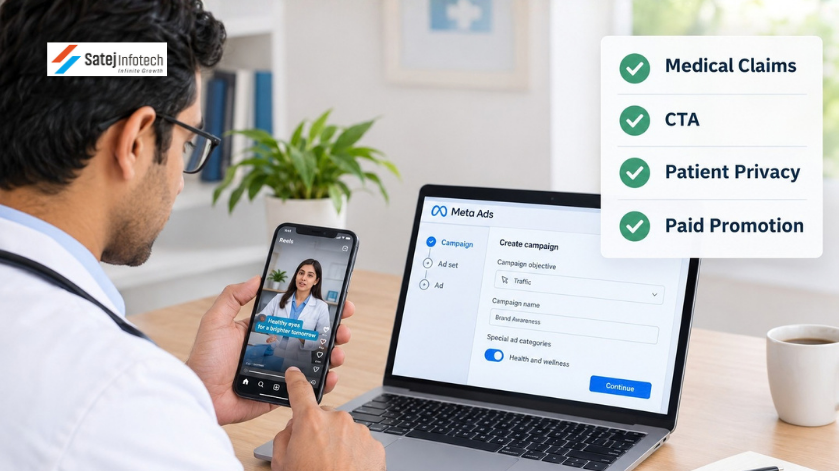
A doctor creates an educational Instagram Reel about PCOS, diabetes, acne or eye health. The information is accurate. The intention is to educate people. The Reel starts getting some engagement. The doctor now considers boosting it to reach a larger…
On this page
- 1. First, Understand What Your Reel Is Actually Promoting
- 2. Review the Call to Action (CTA)
- 3. Check Medical Claims, Success Rates and Promises
- 4. Be Especially Careful With Patient Photos and Before-and-After Images
- 5. Check Medical Accuracy, Identity and Patient Privacy
- 6. Does Choosing Engagement as the Meta Ads Objective Make It Compliant?
- 7. What About Boosting an Existing Reel Versus Creating a New Meta Ad?
- 8. The Doctor’s Pre-Launch Checklist
- 9. The Practical Approach: Review Before You Spend
A doctor creates an educational Instagram Reel about PCOS, diabetes, acne or eye health.
The information is accurate. The intention is to educate people. The Reel starts getting some engagement.
The doctor now considers boosting it to reach a larger audience.
But here’s an important question:
Does choosing the Engagement objective in Meta Ads automatically make the promotion acceptable under the applicable medical ethics guidelines?
No. The campaign objective is a Meta advertising setting. It does not determine whether the content and its promotion meet professional requirements.
The National Medical Commission (NMC) published its Guidelines on Ethical Advertising and Public Communication by Hospitals/Medical Institutions and Registered Medical Practitioners on 6 October 2026. The guidelines address ethical advertising and public communication by doctors and healthcare institutions.
For doctors considering Instagram boosts or Meta Ads, this means looking beyond the video itself.
The Reel, caption, call to action, paid distribution, audience targeting and destination should all be considered in context.
This article provides a practical checklist to help doctors identify issues that need review before launching a campaign. It is an educational guide, not a blanket declaration that all educational Reels can be boosted or that all paid educational content is automatically prohibited.
Doctors should also review our Doctor Marketing Claims Checklist before publishing medical content that discusses treatment outcomes.
1. First, Understand What Your Reel Is Actually Promoting
Two Reels can discuss the same medical condition but communicate very different messages.
Consider these examples.
Example A: Public-health education
A doctor explains common symptoms of PCOS, discusses when medical evaluation may be appropriate and shares general health information.
The primary content is educational. Its full context and intended use still need to be reviewed before paid promotion.
Example B: Practice promotion
A doctor discusses PCOS but also emphasises personal expertise, highlights the clinic’s services and encourages viewers to become patients.
The content may now have a promotional purpose, even though the subject is medical education.
The medical topic alone does not settle the question.
The NMC’s October 2026 guidelines address advertising and promotional communication, including social media and sponsored communication. They must be read alongside the applicable professional conduct requirements.
Practical rule: Before boosting a Reel, ask whether the complete communication is providing public-health information or promoting an individual doctor’s professional services.
Do not assume that adding educational information makes every promotional element acceptable.
2. Review the Call to Action (CTA)
A call to action tells viewers what to do next. It can influence how a Reel is understood, but the CTA alone does not determine compliance.
Review the wording alongside the video, caption, profile and campaign destination.
A CTA that sounds educational does not automatically make the entire campaign compliant. Similarly, reviewing only the final sentence while ignoring the rest of the advertisement is not sufficient.
Before boosting, examine what happens when someone follows the CTA. Does it lead to an educational resource, a promotional landing page or a direct request for a consultation?
That destination is part of the wider communication you should review.
For a more detailed review, follow our Doctor CTA: Education vs Patient Solicitation Checklist to evaluate how your call to action may be interpreted.
3. Check Medical Claims, Success Rates and Promises
Medical content needs to be accurate and presented responsibly.
Before promoting a Reel, review the statements it makes about diagnosis, treatment, outcomes and the doctor’s professional standing.
Be particularly cautious with phrases such as:
- “Best Doctor”
- “No. 1 Specialist”
- “100% success rate”
- “Guaranteed results”
- “Permanent cure”
- “Results guaranteed in 7 days”
These statements can create misleading expectations, imply superiority or promise outcomes that cannot be guaranteed for every patient.
Even if a doctor intends to simplify a medical concept, the final wording must not mislead viewers.
What should doctors check?
Ask these questions:
- Are the medical statements accurate and supported?
- Is the wording appropriate for the intended audience?
- Does the Reel imply a guaranteed treatment outcome?
- Does it exaggerate the doctor’s experience or achievements?
- Could a viewer interpret a general statement as a promise about their individual case?
A disclaimer does not automatically fix a misleading claim. Review the underlying statement rather than relying on a small-print qualification.
4. Be Especially Careful With Patient Photos and Before-and-After Images
This deserves a separate review because visual content can communicate a claim even when the caption does not make one explicitly.
For example, a Reel may show a patient’s skin before and after treatment. The doctor may intend to demonstrate a clinical concept, but viewers could interpret the images as evidence of the results they can expect from the same treatment.
The same concern applies to:
- Patient testimonials
- Patient success stories
- Treatment-result comparisons
- Images showing healed or treated patients
- Videos that highlight impressive clinical outcomes
The NMC’s existing professional conduct framework addresses patient testimonials, endorsements and the public presentation of clinical results. The October 2026 guidelines should be checked for their specific requirements before any such material is published or promoted.
Before using patient-related content, review our Patient Testimonial & Social Media Checklist for Doctors to understand the important considerations surrounding patient privacy, consent and professional communication.
Does patient consent make the content acceptable?
Consent and professional compliance are separate questions.
Consent may be relevant to whether patient information or images can be used. It does not automatically make otherwise restricted promotional content permissible.
Before using patient-related content, doctors should review:
- Whether the content itself is permitted under the applicable professional requirements.
- Whether valid and appropriate consent has been obtained where required.
- Whether the patient could be identified from the image, voice, caption or surrounding details.
- Whether the presentation could mislead viewers about expected treatment outcomes.
- Whether paid promotion changes the context in which the content will be seen.
If the content is potentially restricted or the interpretation is uncertain, seek appropriate professional advice before boosting it.
5. Check Medical Accuracy, Identity and Patient Privacy
A Reel may appear educational but still require corrections before publication or promotion.
Use this checklist.
Medical accuracy
Verify factual claims and avoid misleading descriptions of diagnosis, treatment or outcomes.
Professional identity
Check the applicable requirements for displaying the doctor’s name, qualifications and registration details.
Patient privacy
Check for identifiable patient information in the video, audio, screenshots, records and captions.
Complete campaign
Review the Reel together with its caption, CTA, profile, landing page and other campaign elements.
Do not assume that checking the video alone is enough. A caption or landing page may introduce promotional claims that are not obvious in the Reel itself.
Use our Doctor’s NMC-Safe Digital Marketing Checklist to review important considerations before publishing or promoting medical content online.
6. Does Choosing Engagement as the Meta Ads Objective Make It Compliant?
No.
Meta’s Engagement objective is designed to optimise a campaign for selected engagement-related actions. It is a platform setting, not a medical ethics classification.
For example, a doctor might boost an educational Reel and choose Engagement to increase likes, comments or shares.
That choice does not, by itself, establish whether the campaign complies with the NMC guidelines.
The same principle applies when you boost an existing Instagram Reel rather than creating a new advertisement.
Before launching the campaign, consider:
- What is the content communicating?
- Is the communication educational, promotional or a combination of both?
- Does it make claims about the doctor, clinic or treatment?
- Does it contain patient material or clinical outcomes?
- What action is the viewer encouraged to take?
- Where will the viewer go after interacting?
- How will the content be distributed and targeted?
The NMC’s October 2026 guidelines identify social media and sponsored communication within their advertising framework. Therefore, changing a Meta campaign objective should not be treated as a substitute for reviewing the communication itself.
7. What About Boosting an Existing Reel Versus Creating a New Meta Ad?
From a practical review perspective, both require attention.
When you boost an existing Reel, the content may already have been published organically. However, paying to distribute it introduces a different distribution context.
When you create a new Meta ad, the creative, primary text, headline, CTA and destination may work together to communicate the message.
In either case, review the complete communication before spending money.
Neither format is automatically compliant or non-compliant simply because of how it was created.
The applicable guidelines and the actual content determine what needs to be assessed.
8. The Doctor’s Pre-Launch Checklist
Use this checklist before approving an Instagram Reel for boosting or preparing a new Meta Ads campaign.
Before You Boost That Reel
0/9
I have reviewed the Reel and caption together.
I have considered the purpose and overall presentation of the campaign.
The content does not contain misleading medical claims or unsupported promises.
I have checked patient photos, testimonials and treatment results against applicable restrictions.
The content does not improperly disclose identifiable patient information.
Required professional identity and registration details have been reviewed.
I have checked the CTA and the destination it leads to.
I have considered paid distribution and audience targeting.
Any uncertain or potentially high-risk content has been reviewed before launch.
Copy checklist
This checklist helps identify issues for review. Completing it does not certify that a campaign complies with the applicable guidelines.
If you cannot confidently assess a particular claim, patient image, testimonial or promotional element, pause the campaign and obtain appropriate advice before proceeding.
9. The Practical Approach: Review Before You Spend
Doctors do not need to approach every educational Reel with the assumption that paid promotion is automatically prohibited.
They also should not assume that a Reel is acceptable to boost simply because the content is educational or because the Engagement objective is selected.
The more useful approach is to review the complete campaign against the applicable professional requirements.
That includes the content, wording, visual material, CTA, destination and intended promotional purpose.
The key question is not simply, “Can I boost this Reel?”
It is:
“Have I reviewed this complete campaign against the applicable NMC guidelines before paying to distribute it?”
That is a much better starting point for responsible digital marketing for doctors.
Frequently Asked Questions About Doctor’s Checklist for Meta Ads
1. Can doctors boost educational Instagram Reels under the new NMC guidelines?
Do not assume that all educational Reels are automatically permitted for paid promotion or that every educational Reel is automatically prohibited. The content, purpose, presentation and paid distribution should be assessed against the applicable guidelines. Seek professional advice where the position is uncertain.
2. Does the Meta Ads Engagement objective make an advertisement compliant with NMC guidelines?
No. Engagement is a Meta campaign objective, not a medical ethics classification. The campaign still needs to be reviewed against applicable professional requirements.
3. Is boosting an existing Instagram Reel different from creating a new Meta ad?
The formats and setup may differ, but both require a review of the complete communication. An existing organic Reel should not be assumed to be suitable for paid distribution without further assessment.
4. Can doctors use patient testimonials in boosted Reels?
Patient testimonials require particular caution under medical professional conduct requirements. Check the current NMC guidelines and applicable rules before publishing or promoting testimonial content. Patient consent alone does not establish that promotional use is permissible.
5. Can doctors use before-and-after images in Instagram advertisements?
Before-and-after images can communicate implied treatment claims and raise professional ethics concerns. Doctors should review the specific content against the applicable restrictions rather than assuming that educational intent or patient consent makes it acceptable.
6. Can a doctor use “DM me to book your consultation” in a boosted Reel?
A direct consultation CTA should receive careful review because it may turn an educational communication into a patient-acquisition appeal. Assess the complete campaign under the applicable professional requirements rather than judging the CTA in isolation.
7. What should doctors check before running Meta Ads?
Review the Reel or creative, caption, CTA, medical claims, patient information, professional identity details, audience targeting and landing page. Where any element raises uncertainty, obtain appropriate advice before launching.
8. Where can doctors read the official NMC guidelines?
The National Medical Commission published the Guidelines on Ethical Advertising and Public Communication by Hospitals/Medical Institutions and Registered Medical Practitioners on 6 October 2026. Doctors should consult the official NMC notice and accompanying PDF and the applicable professional conduct regulations.