

Before & After Content Checklist for Doctors: 10 Things to Check Before You Post
A practical review for doctors before publishing patient before-and-after photographs on social media.
Before-and-after photographs are commonly used to show the difference between two points in a treatment journey.
But for doctors, a before-and-after post is not simply a photograph.
The way the image is presented, the caption written, and the CTA added can change how the entire post is perceived.
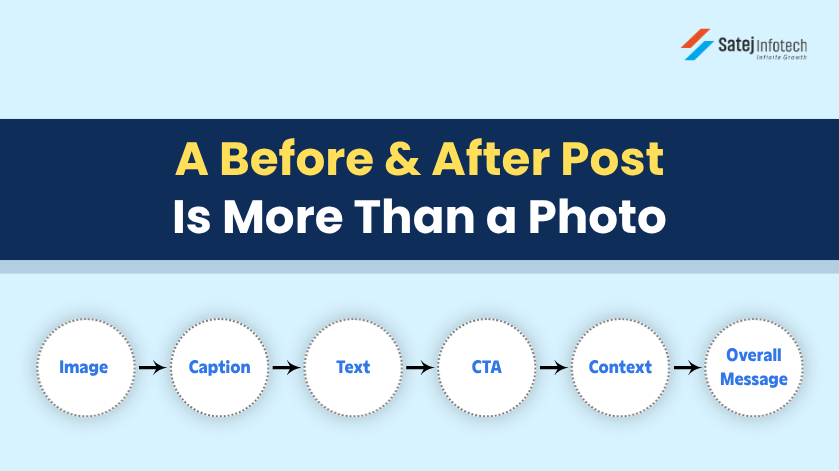
Before you publish, take a moment to review the image + caption + text + CTA + context together.
Use this 10-point checklist.
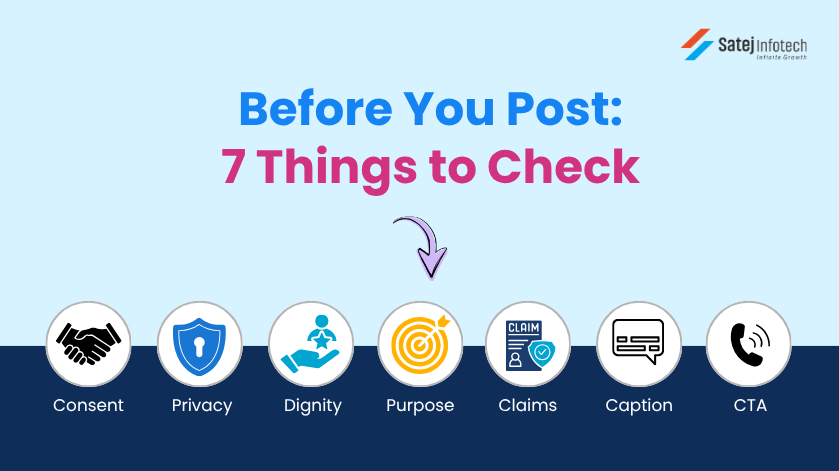
1. Do I Have the Patient's Consent?
Start with consent.
Ask yourself:
☐ Has the patient clearly consented to the use of their photograph?
☐ Do they understand that the photograph will be published on social media?
☐ Do they understand how the image will be used?
Patient consent is an important part of handling patient-related content.
For a broader review of patient-related social media content, see our Patient Testimonial & Social Media Checklist for Doctors.
But it should not be the only check you make.

2. Have I Protected Patient Privacy?
Look carefully at the complete image.
Check whether it reveals:
- Name
- Phone number
- Medical records
- Reports
- Case sheets
- Other personal information
Ask:
“Is there any information visible that does not need to be there?”
Remove unnecessary identifying or private information before considering publication.
3. Is the Patient's Dignity Protected?
A medical photograph should always be handled respectfully.
Ask:
☐ Is the image presented professionally?
☐ Is the patient being represented with dignity?
☐ Would the patient be comfortable seeing this image publicly?
☐ Would I still consider the presentation respectful if the post reached thousands of people?
Patient dignity should come before engagement.
4. Why Am I Posting This?
This is one of the most important questions.
Ask yourself:
“Am I educating the audience or showcasing a result to promote my practice?”
A photograph can potentially be used in an educational context.
But if the primary purpose is to showcase a result and convince prospective patients to choose your practice, you need to review the complete communication carefully.
Look at:
The image + caption + CTA + context
—not just the photograph itself.
5. Am I Presenting the Result as a Promise?
Look at the wording around your photograph.
Avoid language that suggests another patient can expect exactly the same outcome.
For example:
❌ “You can get the same result.”
❌ “This treatment will work for you.”
❌ “Guaranteed outcome.”
One patient’s treatment journey does not automatically represent the outcome another patient will experience.
For more guidance on wording and treatment-related promotional claims, see our Doctor Marketing Claims Checklist.
6. Check Your Caption
The photograph may look neutral, but the caption can turn it into promotional content.
Be particularly careful with phrases such as:
❌ “Amazing results!”
❌ “Another successful case!”
❌ “See what we can do for you!”
Instead of making the result the selling point, consider whether the content can provide useful educational context about:
- The condition
- The treatment approach
- What the procedure involves
- General recovery information
- Factors that can influence outcomes
Explain. Don’t exaggerate.
7. Avoid Superlatives
Review both the image and caption for claims such as:
❌ Best treatment
❌ Best doctor
❌ No. 1 clinic
❌ Leading specialist
A before-and-after image doesn’t need a superlative to demonstrate expertise.
Focus on factual information about:
- Your specialty
- Qualifications
- Treatment approach
- Professional experience
You can also review our NMC-Safe Social Media Checklist for Doctors before publishing professional or promotional content.
8. Avoid Creating Unrealistic Expectations
Ask yourself:
“Could a patient look at this photograph and assume this is the result they will definitely get?”
If yes, review the presentation.
Individual treatment outcomes can vary.
Avoid presenting one patient’s result as though it is a typical or guaranteed result for everyone.
9. Check Your CTA
The CTA can significantly change the tone of the post.
Be particularly careful when a before-and-after photograph is followed by:
❌ “Book now to get the same results.”
❌ “DM us today for your transformation.”
The combination of:
Before & After + Outcome Claim + Promotional CTA
deserves a second review.
Your CTA should not turn an individual patient’s result into a promise for prospective patients.
10. Review the Complete Post
Don’t review only the photograph.
Review everything together:
A photograph that appears neutral on its own can take on a very different meaning when combined with promotional wording.
The final question:
“What message will a prospective patient take away from this entire post?”
That is the message you should evaluate.
Your social media post is only one part of your broader online presence. For the next step, review our Google Visibility Checklist for Doctors.
The Quick Before-Posting Check
✅ Before Publishing, Run Through:
⚠️ If something feels promotional or creates an expectation of a particular result, stop and review it before publishing.
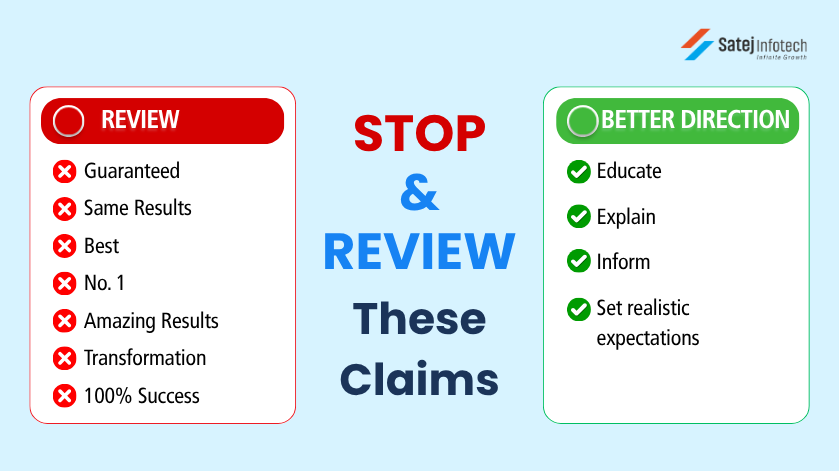
STOP & REVIEW THESE WORDS
If you see any of these in your caption or graphic, take another look:
Guaranteed
Same results
Best
No. 1
Amazing results
Transformation
100% success
The presence of a word doesn’t automatically determine whether a post is permissible in every context.
But these types of claims should prompt a careful professional review, particularly when they relate to treatment outcomes or superiority.
The Key Takeaway
A before-and-after photo isn’t just a photograph.
The way you frame and promote the result matters.
Before posting patient-related content, don’t ask only:
“Do I have permission?”
Also ask:
“Does this post protect privacy, respect dignity, avoid unrealistic expectations, and communicate responsibly?”
That extra review can help you build a professional digital presence without turning a patient’s treatment journey into an exaggerated marketing claim.
For more practical ideas on what to publish next, explore our 100 Content Ideas for Doctors.
Want More Practical Marketing Guidance for Doctors?
At Doctor Growth System by Satej Infotech, we help doctors build their digital presence through practical, patient-focused digital marketing.
Our services include:
- Social Media Strategy
- Doctor Branding
- Content Planning
- Local SEO
- Google Business Profile Optimization
- Healthcare Website Development
- Patient-focused Digital Marketing
Want a FREE 15 Min Marketing Audit for Your Practice?
Click the WhatsApp button below. 💬 Message “FREE 15 min Marketing Audit” on WhatsAppFrequently Asked Questions
Before-and-after photographs require careful consideration of patient consent, privacy, dignity, the purpose of the post, treatment-outcome claims, and applicable professional requirements. The photograph should not be evaluated in isolation from its caption and context.
Consent is an important consideration, but it should not be the only review. Doctors should also consider privacy, dignity, professional conduct, the purpose of publication, and whether the content creates unrealistic expectations.
Doctors should avoid presenting one patient's outcome as a result that another patient can expect or is guaranteed to achieve. Individual medical outcomes can vary.
Patient-related content should be carefully reviewed before publication. In addition to consent, doctors should consider whether the content is educational or primarily promotional and whether the overall presentation creates expectations about treatment outcomes.
Where such content is appropriate, the caption should provide factual and educational context rather than exaggerating the result or promising that other patients will achieve the same outcome.
"100% success" is an absolute outcome claim and should be treated as high-risk marketing language. Doctors should avoid unsupported or misleading claims about treatment outcomes.
A CTA can change the overall character of a post. CTAs that promise the same result, encourage immediate treatment, or use transformation-focused promotional language deserve careful review.