
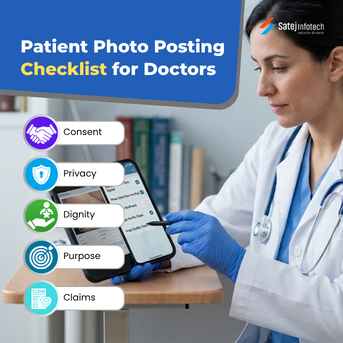
Patient Photo Posting Checklist for Doctors: 10 Things to Check Before You Post
Before you share a patient’s photograph on Instagram, Facebook, your website, or any other digital platform, take a moment to review these 10 points.
A patient photograph may look like a simple piece of content.
But once it is published online, it can become part of a much larger digital footprint.
So the question isn’t only:
“Did the patient agree to the photograph?”
You also need to consider consent, privacy, medical information, dignity, purpose, claims, and the context in which the photograph is being used.
Use this checklist before you hit Publish.
1. Do I Have Clear Consent?
Start with consent.
Ask yourself:
☐ Has the patient agreed to the photograph being taken?
☐ Have they agreed to its public use online or on social media?
☐ Do they understand what the photograph will be used for?
Consent for treatment should not automatically be assumed to mean consent for photographing or publicly publishing the patient’s image.
Remember:
Consent to treatment ≠ automatically consent to social media publication.
Consent is only one part of responsible patient-content publishing. For guidance on using patient experiences and testimonials across digital platforms, see the Patient Testimonial & Social Media Checklist for Doctors.
2. Does the Patient Understand Where It Will Be Used?

Be clear about the intended use.
The photograph could potentially appear on:
- Your website
- YouTube
- Other digital platforms
Ask:
“Does the patient understand that this photograph may be publicly visible online?”
The patient should know the intended digital use rather than assuming that the photograph will remain within the clinic.
3. Does the Photograph Identify the Patient?
Look carefully at the image.
Ask:
☐ Is the patient’s face visible?
☐ Is their name visible?
☐ Is their location identifiable?
☐ Is there any report or document visible?
☐ Is there other information that could identify the patient?
Even if you haven’t written the patient’s name in the caption, the photograph itself may make the person identifiable.
Before publishing:
Look at the entire frame—not just the main subject.
4. Am I Revealing Medical Information?
A photograph can reveal more than you initially realize.
Ask:
☐ Does the photograph reveal a diagnosis?
☐ Does it show a treatment or procedure?
☐ Does it reveal a medical condition?
☐ Is every visible detail necessary for the intended educational purpose?
If the photograph contains sensitive medical information, consider whether it is actually necessary to publish that information.
The simple question:
“Does the audience need to see this detail to understand the educational message?”
If not, reconsider including it.
5. Is the Photograph Respectful?
Patient dignity should remain a priority.
Ask:
☐ Is the photograph presented professionally?
☐ Does it protect the patient’s dignity?
☐ Is the patient’s body or medical condition being shown appropriately?
☐ Would the patient still feel comfortable seeing this photograph publicly?
Remember that something that may appear routine to a healthcare professional can feel very personal to a patient.
Engagement should never come at the cost of patient dignity.
6. Why Am I Posting It?
This is one of the most important questions in the checklist.
Ask yourself:
“Is there a genuine educational reason for sharing this photograph?”
Now ask the harder question:
“Or am I primarily using the photograph to showcase my practice and attract patients?”
The purpose and context matter.
Before publishing patient-related content, it is also useful to review the broader NMC-Safe Posting Checklist.
A photograph used as part of an educational explanation is different from a photograph presented as a reason for prospective patients to choose your clinic.
Before publishing, look at:
Photo + Caption + Text + CTA
—not just the photograph.
7. What Does the Caption Say?
The same photograph can communicate very differently depending on the caption.
Be particularly careful with language such as:
❌ “Another amazing result.”
❌ “See what we can do for you.”
❌ “Get the same results.”
❌ “Book your treatment today.”
The photograph might appear neutral on its own.
But the caption can turn the overall post into promotional communication.
Always review the image and caption together.
Pay particular attention to promotional wording and treatment-related claims. Use the Doctor Marketing Claims Checklist to review the language surrounding the photograph.
8. Am I Making a Treatment or Outcome Claim?
A patient’s photograph should not automatically become evidence of what another patient can expect.
Ask:
☐ Does the photograph imply that another patient will achieve the same result?
☐ Am I presenting this individual outcome as typical?
☐ Does the caption suggest a guaranteed outcome?
Be particularly cautious with phrases such as:
“Same results”
“Guaranteed results”
“100% success”
“Works for everyone”
Remember:
One patient’s experience is not a guarantee of another patient’s outcome.
If the photograph is being presented as a before-and-after treatment result, review the Before & After Content Checklist for Doctors before publishing.
9. Have I Considered the Digital Footprint?
Once something is published online, you may have limited control over where it goes next.
Ask:
☐ Could the photograph be downloaded?
☐ Could it be shared or reposted?
☐ Could it appear on another website or platform?
☐ Am I comfortable with the photograph being permanently associated with the patient’s medical journey?
This is why the decision to publish should be considered carefully before the photograph goes online.
The same consideration applies when patient content is incorporated into treatment-related videos. See the Patient Treatment Video Checklist for Doctors before publishing patient video content.
10. Have I Reviewed the Complete Post?
🔍 This Is the Final Check.
Don’t review only the photograph.
Review:
A photograph may appear acceptable in isolation while the complete post communicates something much more promotional.
For a broader review of professional social-media communication, use the NMC-Safe Posting Checklist.
So ask:
“What will a prospective patient take away from this entire post?”
That is what you need to review.
📸 Before Posting a Patient Photograph, Ask 5 Questions
CONSENT?
Has the patient agreed to the intended public use?
PRIVACY?
Have I protected identifying and medical information?
DIGNITY?
Is the patient being presented respectfully?
PURPOSE?
Is there a genuine educational reason for sharing the image?
NO PROMISES?
Does the post avoid creating unrealistic expectations about treatment outcomes?
⚠️ If you cannot confidently answer yes to all five: Pause before publishing.
For a broader review of your doctor’s online presentation, you can also use the 5-Point Doctor Profile Check.
STOP & REVIEW
If your photograph is accompanied by language such as:
Guaranteed
Same results
Best
No. 1
Amazing results
Transformation
100% success
take another look at the complete post.
The issue isn’t simply one word.
The important question is what the overall communication is telling prospective patients.
The Key Takeaway
A patient’s consent is important.
But before putting a patient’s photograph online, don’t stop at:
“They gave permission.”
Also consider:
Privacy.
Dignity.
Purpose.
Medical information.
Treatment claims.
The overall presentation.
Because a patient photograph isn’t just a photograph once it becomes part of your public digital presence.
Protect the patient first. Review the entire message before you publish.
Patient content is only one part of a doctor’s digital presence. For a broader view of how your practice appears online, see the Google Visibility Checklist for Doctors.
Want More Practical Marketing Guidance for Doctors?
Creating content for doctors requires more than attractive graphics and Reels.
The message, wording, claims, patient information and overall presentation all matter.
At Doctor Growth System by Satej Infotech, we help doctors build their digital presence through:
Our services include:
- Social Media Strategy
- Doctor Branding
- Content Planning
- Local SEO
- Google Business Profile Optimization
- Healthcare Website Development
- Patient-focused Digital Marketing
Want a FREE 15 Min Marketing Audit for Your Practice?
Click the WhatsApp button below. 💬 Message “FREE 15 min Marketing Audit” on WhatsAppFrequently Asked Questions
Patient photographs require careful consideration of consent, privacy, dignity, purpose, and applicable professional requirements. The photograph should also be reviewed together with its caption, text and CTA.
Consent is an important consideration, but it should not be the only check. Doctors should also consider privacy, dignity, intended use, medical information, treatment claims and the overall context of the post.
Not necessarily. Consent for medical treatment and consent for recording or publicly publishing a patient's photograph are different considerations. The intended use of the photograph should be made clear.
Doctors should carefully review patient photographs before publishing them online, including whether the patient has appropriately consented to the intended use, whether privacy is protected, and whether the overall post creates a promotional or misleading impression.
An identifiable patient photograph requires particular attention to consent and privacy. Doctors should ensure that the intended public use is appropriately consented to and that the presentation remains respectful and professionally appropriate.
The purpose and presentation matter. A photograph used primarily to showcase a practice or treatment outcome should be reviewed carefully, particularly if it is combined with promotional claims or promises about results.
Doctors should be cautious with language that exaggerates an outcome or creates unrealistic expectations. The photograph and caption should be reviewed together rather than treating the image as separate from the marketing message.
Any patient-related treatment-result content should be carefully reviewed for consent, privacy, dignity, professional requirements and whether the presentation could imply that other patients will achieve the same outcome.