
Patient Testimonial & Social Media Checklist for Doctors
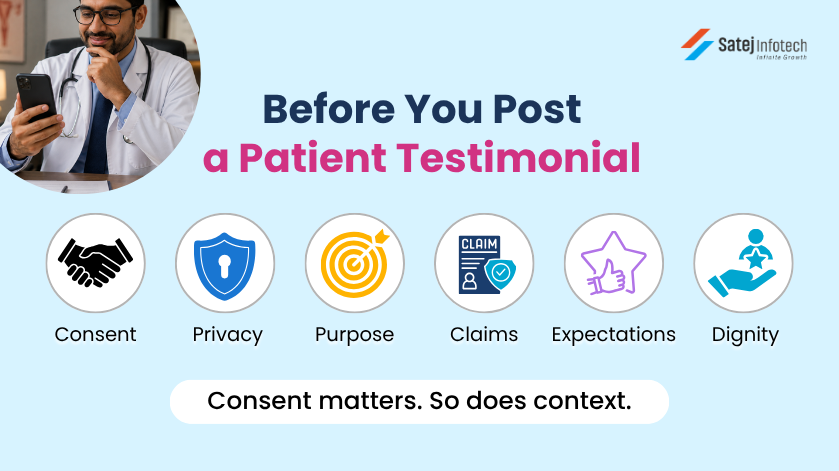
Before You Post a Patient Testimonial, Ask These 10 Questions
Patient stories can feel powerful.
A real patient’s experience can make a social media post more relatable and help people understand what a treatment journey may involve.
But patient-related content requires extra care.
Before posting a testimonial, treatment journey, patient photograph, video, or before-and-after content, take a moment to review it.
Use this 10-point checklist before you hit Publish.
1. Do I Have the Patient's Informed Consent?
Start with consent.
Ask yourself:
☐ Has the patient clearly agreed to the use of their testimonial, photograph, or video?
☐ Do they understand where the content will be published?
☐ Do they understand how their story or image will be presented?
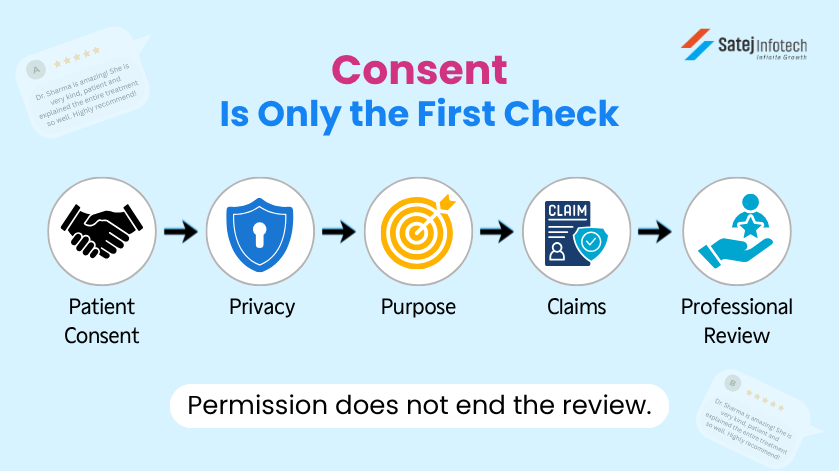
Consent is an important first step when using patient-related content.
For broader guidance on responsible healthcare content, see our NMC-safe social media checklist for doctors.
But remember:
Consent does not automatically answer the professional-conduct question.
You still need to consider whether the content itself is appropriate.
2. Am I Protecting the Patient's Privacy?
Look carefully at everything included in the post.
Could the patient be identified through:
- Name
- Face
- Medical records
- Reports
- Scan images
- Personal information
- Other identifying details
Ask:
“Does this post reveal more about the patient than is actually necessary?”
Protecting patient privacy should remain a priority, even when the patient has agreed to participate.
3. Why Am I Posting This?
This is one of the most important questions.
Ask yourself:
Is the primary purpose patient education?
Or:
Is the testimonial primarily being used to promote my practice and attract new patients?
A patient story can be informative.
But when it is presented primarily as a reason for other people to choose your clinic, the nature of the communication changes.
Again:
Consent does not automatically answer the professional-conduct question.
Look at the purpose, wording, presentation, and CTA together.
You can also review our Doctor Marketing Claims Checklist before publishing promotional healthcare content.
4. Does the Testimonial Make a Treatment-Outcome Claim?
Read the patient’s words carefully.
Watch for statements such as:
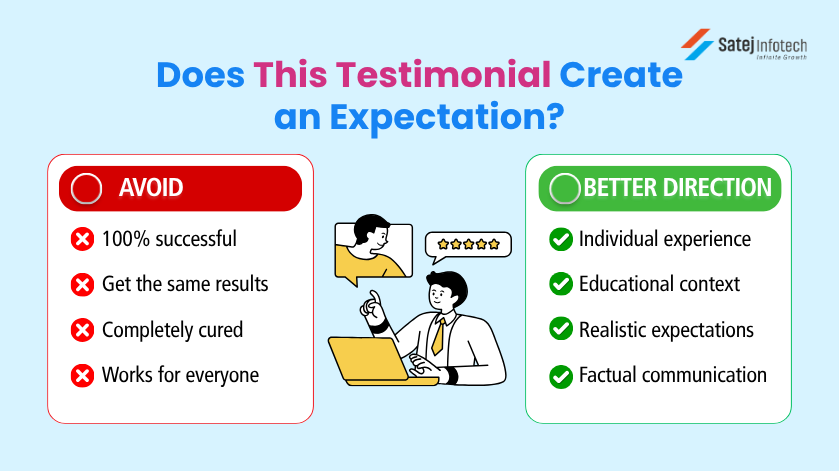
❌ “Dr. X completely cured me.”
❌ “This treatment changed my life.”
❌ “100% successful treatment.”
❌ “I recommend this doctor to everyone.”
These statements can create expectations about treatment outcomes.
A patient’s individual experience does not mean another patient will have the same experience.
5. Am I Creating Unrealistic Expectations?
Imagine another patient seeing your post.
What might they think?
Could they interpret the testimonial as:
“If I go to this doctor, I will get the same result.”
If yes, stop and review the presentation.
A patient’s experience is their experience.
For additional guidance on how your online presence should represent your practice, see our 5-Point Doctor Profile Check.
It shouldn’t automatically be presented as an expected result for everyone.
6. Am I Presenting One Patient's Experience as a Typical Result?
This is closely related to the previous point.
A successful patient journey can be emotionally powerful.
But one patient’s outcome doesn’t necessarily represent what every patient will experience.
Avoid presenting an individual story in a way that implies:
“This is what will happen to you too.”
Healthcare outcomes can vary between individuals.
Your content should reflect that reality.
7. Am I Adding Promotional Language to the Testimonial?
Sometimes the testimonial itself isn’t the biggest issue.
It’s what comes after it.
For example:
Patient Testimonial
“My treatment journey was very positive.”
Then:
❌ “Book your consultation now.”
or:
❌ “Get the same results.”
or:
❌ “Your solution is just one consultation away.”
The combination can turn an individual patient experience into a strong promotional message.
Review the testimonial + caption + CTA as one piece of communication.
8. Am I Comparing Myself With Other Doctors?
Check the testimonial and your caption for comparative language.
Avoid turning a patient’s experience into claims such as:
❌ “Best doctor.”
❌ “No. 1 specialist.”
❌ “Better than other clinics.”
❌ “The most successful treatment.”
Your patient’s story doesn’t need to be used to establish superiority over another practitioner.
Focus on factual information and professional expertise.
For more guidance on building a credible online presence, see our NMC-safe social media checklist for doctors.
9. Does the Content Protect the Patient's Dignity?
This is an important check that can easily be overlooked.
Ask:
☐ Is the patient comfortable with how their story is being presented?
☐ Is the photograph or video respectful?
☐ Have I avoided unnecessary personal details?
☐ Would I still consider this presentation appropriate if thousands of people saw it?
A patient’s healthcare journey is personal.
Engagement should never come at the cost of dignity.
10. Would I Be Comfortable Explaining the Post Professionally?
Before publishing, ask yourself:
“Is this helping people understand a medical issue, or is it primarily being used to convince people to choose my practice?”
If you had to explain the purpose of the post to a professional body, could you clearly explain:
- Why you posted it?
- Why you used the patient’s story?
- How privacy was protected?
- What the content is communicating?
- Why the wording was appropriate?
If you’re uncomfortable with the answer, stop and review the post before publishing.
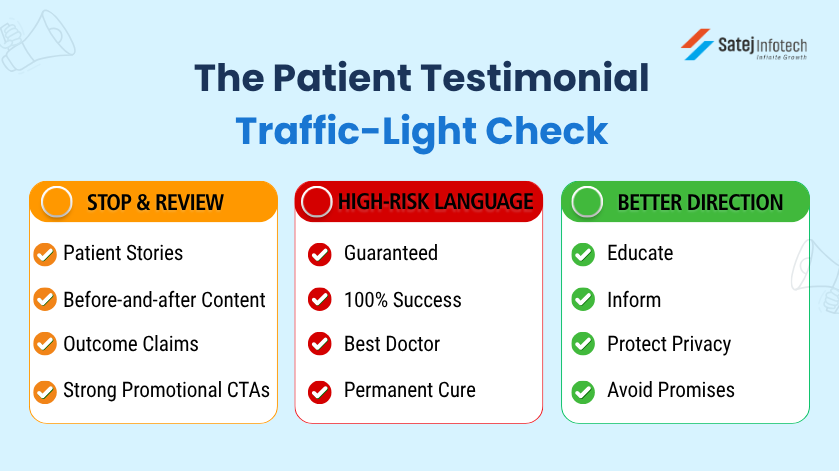
The Quick Traffic-Light Check
When you’re reviewing patient-related content, use this simple framework.
🟠 STOP & REVIEW
These types of content deserve additional scrutiny:
- Patient stories
- Treatment journeys
- Before-and-after content
- Outcome claims
- Strong promotional CTAs
- Success stories
Don’t automatically publish just because you have permission.
Review the complete context.
You can also use our Google Visibility Checklist for Doctors to review your overall online presence.
🔴 HIGH-RISK LANGUAGE
Be particularly cautious with:
- “Guaranteed”
- “100% success”
- “Best doctor”
- “Get the same results”
- “Permanent cure”
- “Works for everyone”
These phrases can create unrealistic expectations or make your content unnecessarily promotional.
🟢 Better Direction
When creating patient-related content, move toward:
💡 This approach allows you to create useful healthcare content without making the patient’s story do the work of an advertisement.
Looking for more ideas for ethical and informative healthcare content? Explore our 100 Content Ideas for Doctors.
The Key Takeaway
A patient’s permission is important.
But permission alone should not be your entire compliance check.
Before posting a patient testimonial or story, consider:
⏱️ Take 30 seconds.
🔁 Read the post again.
And ask:
“Am I educating people—or using this patient’s experience to sell a medical outcome?”
That one question can change how you approach patient-related content.
Want More Practical Marketing Guidance for Doctors?
Healthcare marketing needs a different approach.
At Doctor Growth System by Satej Infotech, we help doctors build their digital presence through:
- Social Media Strategy
- Doctor Branding
- Content Planning
- Local SEO
- Google Business Profile Optimization
- Healthcare Website Development
- Patient-focused Digital Marketing
You can also explore practical AI Tools for Doctors to support content planning and digital marketing workflows.
Click the WhatsApp button below.
💬 Message "FREE 15 min Marketing Audit" on WhatsAppFrequently Asked Questions
Patient testimonials require careful consideration of consent, privacy, purpose, wording, and applicable professional-conduct requirements. Consent alone does not necessarily resolve all ethical or professional concerns.
No. Consent is an important consideration, but doctors should also review whether the content protects privacy, creates unrealistic expectations, makes outcome claims, or is primarily promotional.
Patient stories should be approached carefully. Doctors should consider informed consent, privacy, dignity, the purpose of the post, and whether the story could create expectations about treatment outcomes.
Before-and-after content should be carefully reviewed because it can create expectations about treatment outcomes and may involve patient privacy and professional-conduct considerations.
Doctors should be cautious about publishing testimonials containing definitive treatment-outcome claims such as "cured me" or "100% successful," because an individual patient's experience should not be presented as a guaranteed outcome for others.
Any request for patient feedback should be handled carefully and without pressure. Doctors should also distinguish between genuine patient feedback and using patient endorsements as promotional material.
Patient-related Reels require the same careful review as other content. Consider consent, privacy, dignity, claims, expectations, and whether the overall Reel is educational or promotional.