
Before You Post: The NMC-Safe Social Media Checklist Every Doctor Should Follow
How doctors can build trust online while staying within ethical and professional boundaries.
Introduction
Following the social media guidelines for doctors in India has become essential for building a trusted online presence while complying with NMC expectations. A patient no longer chooses a doctor based only on a referral.
Today, they are likely to:
- Search your name on Google
- Visit your website
- Check your Google reviews
- Browse your Instagram or Facebook page
- Watch a few videos
- Read your educational posts before booking an appointment
A professional online presence has become an important part of modern healthcare. To understand how websites, social media, and digital marketing fit within NMC guidelines, read our Complete Guide to Digital Marketing for Doctors guide.
But with that opportunity comes responsibility.
Many doctors ask questions like:
- Can I post patient success stories?
- Can I share before-and-after photos?
- Can I call myself the best doctor?
- Can I promote discounts or offers?
- Can I ask patients for Google reviews?
- Can my marketing agency create promotional posts?
These questions don’t have simple yes-or-no answers.
These NMC social media guidelines encourage doctors to educate patients while maintaining professional ethics online.
The safest approach isn’t avoiding social media altogether.
Understanding the NMC guidelines for doctors on social media helps reduce the risk of publishing content that could be considered promotional.
That’s exactly what this guide will help you do.

Why Every Doctor Needs a Social Media Checklist in India
Social media moves fast.
Most posts are created in minutes.
Unfortunately, mistakes happen just as quickly.
A single caption containing words like:
- “Guaranteed”
- “Best”
- “100% Safe”
- “Permanent Cure”
can create an impression that goes beyond patient education and moves into promotional territory.
Similarly, sharing:
- Patient Photographs
- Testimonials
- Treatment Guarantees
- Comparison Claims
may expose a doctor to unnecessary ethical concerns.
The good news?
Almost all of these mistakes are preventable.
A simple 30-second review before publishing can dramatically reduce the chances of posting something that doesn’t align with professional expectations.
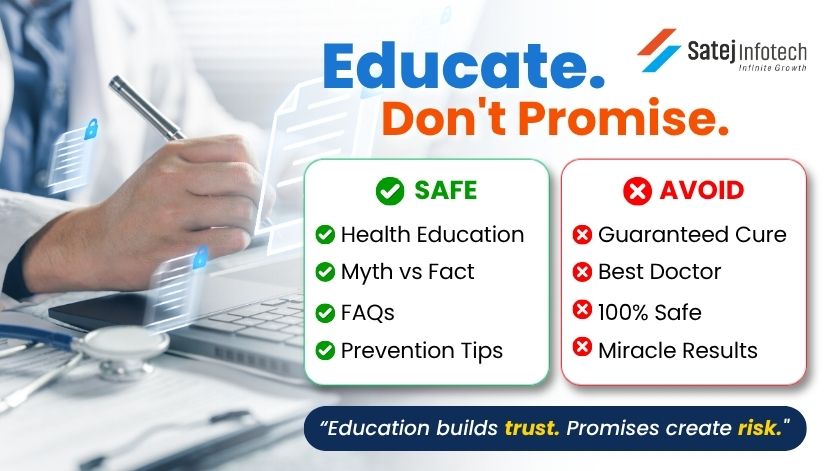
The One Rule Every Doctor Should Remember
Educate. Don’t Promise.
Whenever you’re about to publish content, ask yourself one simple question.
Is this post educating patients or trying to sell medical treatment?
Educational content generally focuses on:
- explaining diseases
- prevention
- symptoms
- treatment options
- recovery expectations
- public health awareness
Promotional content often includes:
- guaranteed outcomes
- exaggerated claims
- superiority statements
- urgency
- comparisons with other doctors
Patients trust doctors because of their expertise—not because of advertising language.
The strongest healthcare brands don’t build trust through bold claims.
They build trust through consistent education.
If you’re looking for inspiration, explore these 100 Content Ideas for Doctors that focus on patient education rather than promotion.
Red-Flag Words That Doctors Should Avoid
Certain words immediately make content sound promotional rather than educational.
While context always matters, it’s generally safer to avoid exaggerated or outcome-based language.
| Avoid Using | Why It Can Be Problematic |
|---|---|
| Best Doctor | Implies superiority over other professionals |
| Top Specialist | Comparative claim |
| No.1 Clinic | Ranking claim |
| Guaranteed Results | No treatment outcome can be guaranteed |
| 100% Safe | Every medical procedure carries some level of risk |
| Permanent Cure | Medical outcomes vary between patients |
| Miracle Treatment | Creates unrealistic expectations |
| Amazing Transformation | Focuses on outcome rather than education |
| Better Than Other Clinics | Comparative advertising |
| Limited Slots – Book Now | Creates promotional urgency |
✓ A Simple Test
Ask yourself:
“Would this sentence sound more appropriate in a shopping advertisement than on a doctor’s page?”
✔ If the answer is yes, rewrite it.
What Doctors Can Safely Post on Social Media
One of the biggest misconceptions is that doctors cannot use Instagram, Facebook, LinkedIn, or YouTube.
That’s simply not true.
Doctors can absolutely build a strong online presence through educational and professional content. If you’re unsure what to publish consistently, explore these content ideas for doctors.
Examples include:
Health Education
- Symptoms of common illnesses
- Prevention tips
- Lifestyle advice
- Vaccination awareness
- Women’s health
- Child healthcare
- Mental wellness
Myth vs Fact Series
Patients love content that clears common misconceptions.
Examples:
- Does cold weather cause fever?
- Can infertility always be treated with IVF?
- Does diabetes only affect older people?
Creating consistent educational content doesn’t have to be time-consuming. These AI tools for doctors can help with content planning, writing, and patient education.
✓ Frequently Asked Questions
Answer the questions patients ask every day.
For Example
- ✔ When should I see an ENT specialist?
- ✔ What is AMH?
- ✔ How long is IVF treatment?
- ✔ When should a child visit a pediatrician?
Explain Procedures
Rather than promising outcomes, explain:
- who may benefit
- how the procedure is performed
- preparation
- recovery
- possible risks
- expected follow-up
Educational explanations help patients make informed decisions.
Professional Information
Doctors may share factual information such as:
- Qualifications
- Degrees
- Registrations
- Fellowships
- Areas of specialization
- Consulting hours
- Clinic address
- Appointment process
Facts build credibility.
Claims create risk.
Content Doctors Should Generally Avoid
Some types of content create significantly higher ethical concerns and should generally be avoided.
These include:
Before-and-After Photos
Even when patients are happy with their results, these images can create unrealistic expectations for others.
Patient Testimonials
Healthcare decisions should be based on professional expertise—not promotional endorsements.
Patient Photographs
Even if permission has been obtained, doctors should exercise extreme caution before publishing identifiable patient images.
Protecting patient privacy should always remain the priority.
Success Rates
Statements such as:
- 95% success
- Highest IVF success rate
- Thousands of successful surgeries
can easily be interpreted as promotional claims.
Treatment Discounts
Healthcare is fundamentally different from retail.
Discount-driven promotions may undermine professional trust and create ethical concerns.
Comparing Yourself to Other Doctors
Statements like:
- Better than…
- Most experienced…
- Highest rated…
- Number one…
are best avoided.
Patients should choose a doctor based on informed confidence—not competitive marketing.
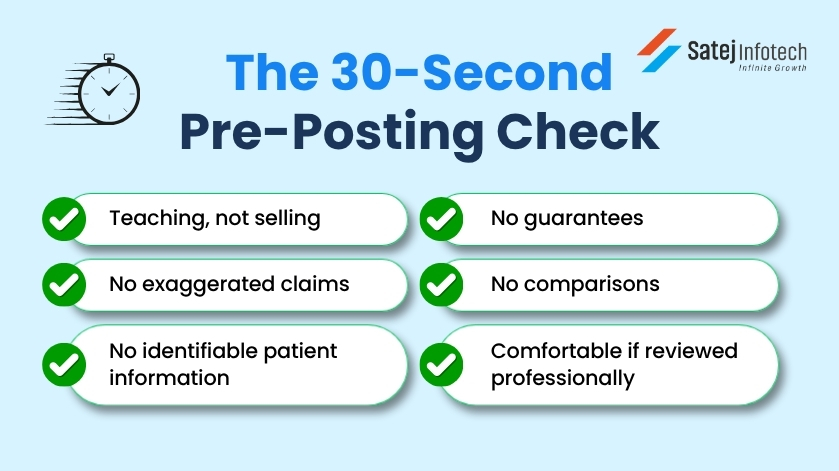
The 30-Second Social Media Check Before Every Post
Before publishing anything, pause for just thirty seconds and ask yourself these six questions.
1. Am I educating or selling?
If you’re teaching, you’re moving in the right direction.
2. Does my caption contain exaggerated words?
Remove words that overpromise or create unrealistic expectations.
3. Can any patient be identified?
Look carefully for:
- Faces
- Names
- Reports
- Scan images
- Medical records
If yes, don’t post until you’re confident privacy is protected.
4. Have I guaranteed any outcome?
Replace absolute statements with realistic language.
For example:
Instead of
“Guaranteed results”
Write
“Treatment outcomes vary depending on the individual.”
5. Am I comparing myself with another doctor?
Professional communication should focus on your own expertise—not someone else’s.
6. Would I be comfortable if this post were reviewed by my State Medical Council?
This is perhaps the most useful question of all.
If the answer makes you hesitate, review the post again before publishing.
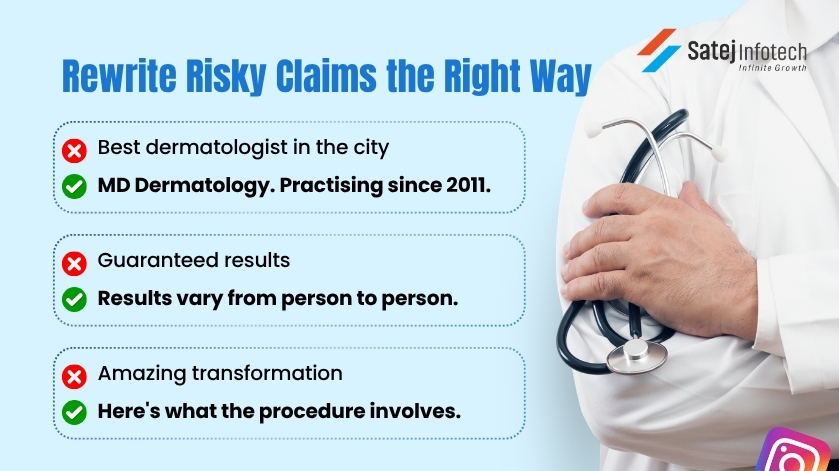
Small Changes That Make a Big Difference
Instead of Saying
"Best dermatologist in the city."
Consider
"MD Dermatology with over 15 years of clinical experience."
Instead of
"100% Safe Procedure."
Write
"Your doctor will explain the benefits, possible risks, and expected recovery before treatment."
Instead of
"Amazing transformation."
Say
"Here's what this procedure involves and what patients can generally expect during recovery."
Notice the difference. One version promotes. The other educates.
That distinction matters.
Already Posted Something You're Unsure About?
Don’t panic.
Many doctors started using social media long before these discussions became common.
If you find older posts that now concern you:
- Archive or delete them if appropriate.
- Review your recent posts.
- Update your bio if it contains promotional language.
- Adopt a better review process going forward.
Improving your approach today is more important than worrying about yesterday.
Google Reviews: What's Safe and What Should Doctors Avoid?
Google reviews for doctors play an important role in helping patients choose a healthcare provider. A strong collection of genuine reviews can build trust and improve your visibility on Google Search and Google Maps.
However, there is an important distinction between encouraging genuine feedback and using reviews as promotional content.
Generally Considered Good Practice
- Patients may voluntarily leave genuine Google reviews.
- You may politely thank patients for their feedback.
- You may encourage patients to share their experience, provided there is no pressure or incentive.
- Respond professionally while protecting patient confidentiality.
Practices to Avoid
- Paying for reviews.
- Offering discounts or gifts in exchange for reviews.
- Writing reviews on behalf of patients.
- Editing patient reviews.
- Posting review screenshots as advertisements or testimonials on social media.
The safest approach is simple:
Deliver excellent patient care, and let authentic reviews follow naturally.
Learn how Google reviews and Google Business Profile help patients find trusted healthcare providers.
Before Hiring a Digital Marketing Agency, Ask These Five Questions
Many marketing agencies understand Facebook, Instagram, and Google Ads.
Very few understand the ethical responsibilities involved in healthcare marketing.
Do you review every post for NMC compliance before publishing?
Healthcare content requires an additional level of review beyond grammar and design.
Do you have a content approval process?
You should always have the opportunity to review and approve content before it goes live.
Will you ever use patient photographs or testimonials?
The answer should clearly explain how patient privacy and ethical considerations are handled.
Who is responsible if a post creates an ethical issue?
A good agency accepts responsibility for following agreed content standards and works collaboratively with the doctor to reduce risk.
Can you show examples of educational healthcare content you've created?
Experience in healthcare marketing matters. Creating content for a retail brand is very different from creating content for doctors.
Does your content focus on educating patients rather than making promotional claims?
Ethical medical marketing in India centres on patient education, transparency, and long-term trust, not exaggerated or promotional claims about outcomes.
Remember
Your professional reputation is built over years but can be damaged by a single careless post.
Choose a marketing partner who understands both digital marketing and healthcare ethics.
The Future of Healthcare Marketing Isn't Better Advertising
- ✔ Many doctors believe they need louder marketing to attract patients — but the opposite is becoming true.
- ✔ Patients are looking for doctors who explain.
- ✔ Doctors who educate.
- ✔ Doctors who answer questions honestly.
- ✔ Doctors who build trust before asking for an appointment.
- ✔ A short educational video explaining sinusitis is often more valuable than an advertisement claiming to be the "best ENT specialist."
- ✔ A well-written blog answering common IVF questions builds more confidence than a flashy promotional graphic.
- ✔ Educational content creates credibility.
- ✔ Credibility builds trust.
- ✔ Trust brings patients.
Educational videos perform particularly well on platforms like Instagram. Before publishing educational content, review this Instagram posting checklist.
A Simple Checklist You Can Save
Before publishing any social media post, ask yourself:
Am I educating rather than selling?
Does my content avoid exaggerated claims?
Have I protected patient privacy?
Have I avoided guarantees or promises?
Have I avoided comparing myself with other doctors?
Would I be comfortable if this post were reviewed by the Medical Council?
If every answer is "Yes," you're far more likely to be creating content that informs patients while maintaining professional standards.
Following these social media best practices for doctors in India helps build trust while maintaining professional standards.
Final thoughts
Social media is no longer optional for most healthcare practices. Patients expect doctors to have an online presence.
The real question isn't whether doctors should use Instagram, Facebook, YouTube, or Google — it's how they should use them responsibly.
The question is how they should use them responsibly.
The most successful doctors online are rarely the loudest.
They are the most helpful.
They consistently educate, answer common questions, explain complex conditions in simple language, and build trust over time — an approach that benefits patients, strengthens your professional reputation, and supports sustainable practice growth.
Before every post, pause for just 30 seconds.
A quick review today can prevent unnecessary problems tomorrow.
Need Help Building an Ethical Digital Presence?
Satej Infotech Pvt Ltd
We specialise in helping doctors build a strong online presence while focusing on educational, patient-first communication. If you want to turn your online presence into a consistent patient acquisition system, explore our Business Growth Services for Doctors in India.
Our healthcare marketing services
🌐
Healthcare Website Design
📍
Google Business Profile Optimization
🔍
Local SEO for Doctors
✍️
Educational Blog Writing
📅
Social Media Content Planning
🤖
AI-Assisted Content Creation
📱
Instagram & Facebook Management for Clinics
Want a FREE 15 Min Marketing Audit for Your Practice?
Click the WhatsApp button below.
Roopali Parandekar | Doctor Growth System
Helping doctors build an ethical and strategic online presence.
📞 WhatsApp: +91 91560 44824
Frequently Asked Questions
Yes. Doctors can use Instagram to educate patients, share health awareness content, explain medical conditions, and answer common questions while maintaining professional and ethical standards.
Before-and-after images can create ethical concerns and should generally be avoided, particularly if they create unrealistic expectations or identify patients.
Doctors may encourage genuine patient feedback without offering incentives or creating pressure. Reviews should always be authentic and voluntary.
Using patient testimonials as promotional content may raise ethical concerns. Doctors should exercise caution and focus on educational content instead.
Healthcare communication should avoid promotional language that turns medical care into a retail product. Consultation fees and clinic information may be shared factually.
Educational posts, FAQs, disease awareness, preventive healthcare, myth-versus-fact content, and explanations of medical procedures are generally among the safest forms of healthcare communication.
A checklist helps doctors review captions, images, and claims before publishing, reducing the risk of misleading content or ethical issues.
Doctors can build trust by consistently publishing accurate, evidence-based educational content, maintaining a professional website, optimizing their Google Business Profile, and avoiding exaggerated claims or comparisons.