
Patient Reviews in Paid Ads for Doctors: 10 Do’s & Don’ts Before You Use One
Can you take a genuine patient review from Google or Instagram and use it in a paid advertisement?
This is a question doctors and clinic marketing teams increasingly face.
A patient may leave a genuine review saying they had a good experience. The review is publicly visible. The marketing team may then think:
“Why not use this review in our Facebook or Instagram ad?”
But there is an important distinction between a review being publicly visible and being appropriate to reuse as paid promotional content.
Once a patient review is placed inside an advertisement, its purpose and context change.
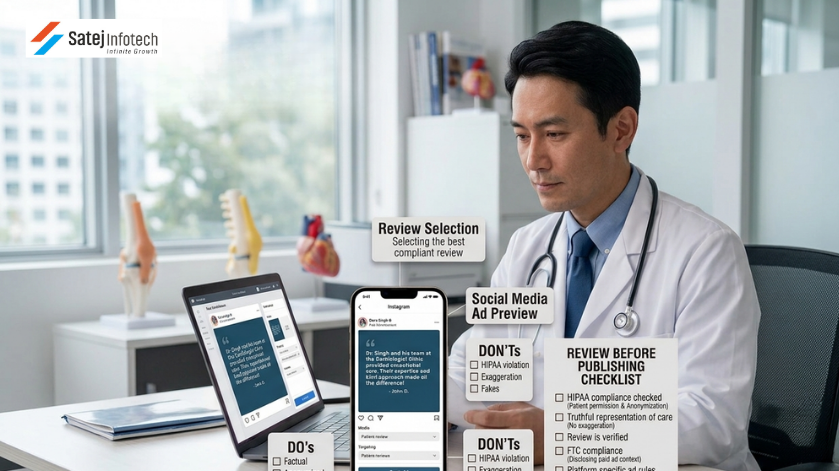
Before using a patient review in a Meta Ad, Google Ad, social media campaign or other paid promotion, use this practical 10-point checklist.
1. Is the Review Genuine?
Start with the most basic question.
☐ Was the review actually written by a real patient?
☐ Does it genuinely represent their experience?
☐ Have you avoided creating a review on their behalf?
☐ Have you avoided manufacturing or manipulating a patient experience?
A review should represent a real patient’s genuine feedback.
Never create a fictional patient experience simply because it would make a better advertisement.
Ask:
“Did this patient actually write this?”
If not, stop.
For a broader review of how doctors can handle patient testimonials on social media, see our Patient Testimonial & Social Media Checklist.
2. Where Did the Review Originally Appear?
Identify where the review came from.
☐ Your website
☐ Another review platform
Now ask:
“Was this review originally provided for this particular marketing use?”
A review being publicly visible does not automatically mean it is approved for every type of marketing use.
There is a difference between:
Patient voluntarily posting feedback
and
Practice actively using that feedback in a paid advertisement.
That distinction deserves consideration before repurposing the review.
If the review originated on Google, also review our Doctor Google Review Checklist before repurposing it.
3. Do You Have Permission to Reuse It?
Before putting a patient’s review into an advertisement, consider whether the patient has agreed to this additional use.
Ask:
☐ Has the patient agreed to the review being used in advertising?
☐ Do they understand that it will be used as promotional content?
☐ Are you also using their name or photograph?
☐ Are you using information about their treatment or medical condition?
Remember:
Publicly visible ≠ automatically approved for every marketing use.
A patient may have written a review publicly without expecting it to become part of a targeted advertisement shown to thousands of people.
For patient-related images and identifying content, also see our Patient Photo Posting Checklist.
4. Does the Review Reveal Patient Information?
Read the review carefully.
Look for:
☐ Patient’s name
☐ Photograph
☐ Medical condition
☐ Treatment details
☐ Procedure
☐ Before-and-after information
☐ Other identifying details
Even if the information appears in a public review, consider whether you need to reproduce it in an advertisement.
If the review reveals sensitive or identifying information:
Stop and review the proposed ad carefully.
Ask:
“Does the advertisement reveal more about this patient’s medical journey than is necessary?”
5. Are You Changing the Patient's Words?
This is an easy mistake to make.
Imagine the original review says:
“I had a good experience.”
The marketing team turns it into:
“Dr. X gave me amazing results!”
That’s no longer simply displaying the patient’s original feedback.
The message has been expanded into a marketing claim.
Don’t turn:
Patient feedback
into
Doctor-generated outcome claims.
If you are quoting a review, make sure you understand exactly what the patient said and how the advertisement presents it.
For more guidance on reviewing promotional language and claims, see our Doctor Marketing Claims Checklist.
6. Does the Advertisement Make a Treatment or Outcome Claim?
Look at the review and everything around it.
🚩 Watch for statements such as:
❌ “Get the same results.”
❌ “Guaranteed results.”
❌ “100% success.”
❌ “This treatment works for everyone.”
❌ “See why our patients are always successful.”
A genuine patient review doesn’t automatically make an outcome claim appropriate.
One patient’s experience is still one patient’s experience.
Don’t turn an individual experience into a promise for everyone.
Review our Doctor Marketing Claims Checklist for additional guidance on guarantees, outcome claims and promotional language.
7. Is the Review Being Used to Solicit Patients?
Now consider the purpose of the advertisement.
Ask:
“Am I simply displaying genuine feedback, or am I using the patient’s experience to convince someone to choose my practice?”
Paid advertising is designed to generate a response.
So look at the complete message:
Patient Review
Doctor / Clinic
Treatment
Outcome
CTA
The more the review is being used to persuade someone to choose a particular doctor or treatment, the more carefully the overall communication should be reviewed.
For the broader professional-safety framework, see our NMC-Safe Posting Checklist.
8. What Does the CTA Say?
Don’t stop reviewing the advertisement once you reach the testimonial.
The CTA matters too.
Review phrases such as:
❌ “Book now for the same results.”
❌ “Get your treatment today.”
❌ “DM us to experience the difference.”
The review may be genuine.
But the CTA can change the overall nature of the advertisement.
Ask:
“What is this advertisement asking the patient to do?”
And:
“Is the CTA turning a patient experience into a strong promotional message?”
For a detailed review of educational versus patient-acquisition CTAs, see our Doctor CTA Checklist.
9. Is the Review Being Used in a Paid Advertisement?
Identify exactly where the content will appear.
☐ Organic social media post
☐ Website
☐ Google Business Profile
☐ Paid Meta Ad
☐ Google Ad
☐ Influencer promotion
A patient review can have a different context when it moves from a review platform or organic post into a paid advertising campaign.
Paid advertising adds another layer to the review’s purpose, audience and distribution.
Before using the review, review the complete advertisement—not just the original feedback.
Before launching the campaign, also review the Doctor Marketing Claims Checklist for the advertising copy and claims.
10. Review the Complete Advertisement
This is the final and most important step.
Don’t approve the review in isolation.
Check:
REVIEW
↓
PATIENT IDENTITY
↓
IMAGE
↓
CAPTION / AD COPY
↓
MEDICAL CLAIMS
↓
CTA
↓
AD OBJECTIVE
↓
OVERALL COMMUNICATION
A genuine review can become problematic depending on how it is edited, framed and used.
Review the entire advertisement before it goes live.
If the advertisement also includes patient photographs or before-and-after material, review the Before-and-After Content Checklist for Doctors and Patient Photo Posting Checklist.
The Quick Patient Review Check
Use this five-point test before putting a patient review into paid advertising.
🟢 BEFORE USING
GENUINE
Is the review authentic?
↓
PERMISSION
Do you have appropriate permission for the intended use?
↓
PRIVACY
Are patient details protected?
↓
ACCURATE
Are you preserving the patient’s actual meaning?
↓
RESPECTFUL
Is the patient’s experience being presented appropriately?
🟠 STOP & REVIEW
Patient identity
Medical details
Outcome claims
Paid promotion
Strong promotional CTA
If any of these appear, review the complete advertisement carefully.
🔴 AVOID
Fake reviews
Manufactured patient experiences
Misleading edits
Guaranteed outcomes
“Get the same results”
Deceptive use of patient experiences
A genuine patient review can be valuable feedback.
But a genuine review is not automatically a free marketing asset.
Before using it in a paid advertisement, ask:
Is it genuine?
Where did it come from?
Do we have appropriate permission for this use?
Does it reveal patient information?
Have we changed the patient’s words?
Does the ad make an outcome claim?
What does the CTA ask people to do?
And most importantly:
“Am I simply displaying patient feedback, or am I using the patient’s experience to promote my practice?”
Review the review + context + claims + CTA + advertising objective together.
At Doctor Growth System by Satej Infotech, we help doctors build their digital presence with a practical, patient-focused approach.
We help with:
- Doctor Social Media Strategy
- Doctor Branding
- Healthcare Content Planning
- Local SEO
- Google Business Profile Optimization
- Healthcare Website Development
- Digital Marketing for Doctors
Want a FREE 15 Min Marketing Audit for Your Practice?
Click the WhatsApp button below. .
💬 Message “FREE 15 min Marketing Audit” on WhatsAppFrequently Asked Questions
A review being publicly visible does not automatically mean it is appropriate for every marketing use. Before using a patient review in paid advertising, consider its original context, appropriate permission, patient privacy, the wording of the advertisement and the applicable professional requirements.
The fact that a review appears publicly on Google does not by itself answer whether it should be reused in a paid Instagram advertisement. Review how the patient's information is being used and whether the patient has agreed to the intended advertising use.
Doctors and their marketing teams should consider whether the patient has given appropriate permission for the review to be reused as promotional advertising, particularly when the advertisement includes identifying or medical information.
Removing a photograph may reduce the amount of identifying information, but the review may still contain a patient's name, condition, treatment details or other information. Review the complete content before using it.
Doctors should be careful about changing a patient's words in a way that alters their meaning or creates a treatment or outcome claim. A marketing team should not turn a simple patient experience into an exaggerated promotional statement.
An individual patient review should not automatically be converted into a general treatment-outcome promise. Statements such as "get the same results" or "guaranteed results" create a substantially different message.
Yes, the context changes. A review originally posted as feedback may become promotional content when incorporated into a paid advertisement. Consider the advertising objective, audience, claims, CTA and how the patient's experience is being presented.
Patient testimonials used in paid advertising should be carefully reviewed against the latest applicable professional, advertising, privacy and platform requirements. Don't assume that a genuine testimonial is automatically suitable for paid advertising.