

Doctor Offers & Discounts Checklist: 10 Things to Check Before You Promote an Offer
Can doctors promote discounts, free consultations or special offers on social media?
This is a question many doctors and clinics ask when planning their digital marketing.
The answer isn’t simply about whether a particular fee or discount exists.
The way the offer is communicated matters.
A factual communication about professional fees is very different from a sales-style advertisement designed to create urgency and push someone towards treatment.
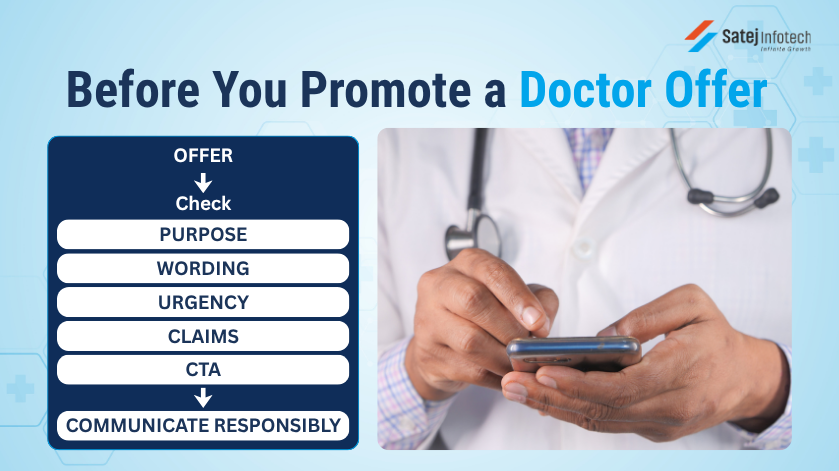
Before publishing a post about a discount, free consultation, package, or special offer, use this 10-point checklist.
1. What Exactly Am I Communicating?
🎯 Start by Identifying the Purpose of the Post
Ask yourself:
OR
For example:
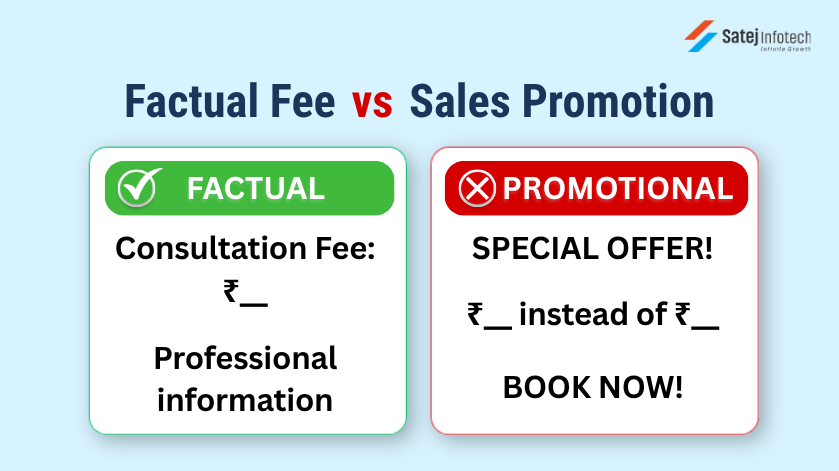
🟢 Factual Communication
“Consultation fee: ₹____.”
🔴 Promotional Communication
“SPECIAL OFFER! Consultation ₹____ instead of ₹____. BOOK NOW!”
The second example is clearly more sales-oriented.
Ask yourself:
“Am I informing the patient about a fee, or am I trying to sell a medical service?”
2. Does the Post Create Urgency?
Look carefully at your wording.
Be cautious with phrases such as:
❌ “Limited time only”
❌ “Last 5 slots”
❌ “Book before midnight”
❌ “Offer ends today”
Urgency is commonly used in commercial marketing to encourage immediate action.
In healthcare communication, ask:
“Is this urgency genuinely necessary, or is it being used primarily to push someone towards seeking treatment?”
If the answer is the second one, review the post carefully.
3. Am I Presenting a Medical Service Like a Commercial Product?
Look at the language and design of the post.
For example:
❌ “20% OFF Treatment”
❌ “Special Treatment Package”
❌ “Festival Offer”
❌ “Flat ₹999 Consultation”
These phrases can make a medical service look like a retail product being promoted through a sales campaign.
Before publishing, step back and look at the overall presentation.
Ask:
“Does this communicate professional information, or does it look like a commercial sales promotion?”
4. Is the Offer Becoming the Main Message?
⚖️ Compare These Two Approaches
🟢 Factual
“Consultation fee: ₹____.”
🔴 Promotional
“SPECIAL OFFER! Consultation ₹____ instead of ₹____. BOOK NOW!”
Both communicate a price.
But the tone and purpose are very different.
The second version combines:
💡 That is why the complete communication needs to be reviewed—not just the price.
5. Is "FREE Consultation" Being Used as a Marketing Hook?
“FREE” is a powerful word in marketing.
So ask:
☐ Is the free consultation genuinely being communicated as information?
☐ Or is “FREE” being used primarily to generate patient enquiries?
Again, look at the complete communication.
For example:
FREE Consultation
followed by:
“Limited slots. Book today!”
has a very different marketing tone from simply communicating information about a consultation initiative.
Don’t evaluate one word in isolation.
Review the headline + image + caption + CTA together.
The same principle applies to other promotional wording. See our Doctor Marketing Claims Checklist for a practical review of claims and marketing language.
6. Am I Making Treatment Claims Alongside the Offer?
This is particularly important.
Don’t combine a promotional offer with outcome promises such as:
❌ “Guaranteed results”
❌ “100% success”
❌ “Permanent cure”
❌ “Get the same results”
A discount does not make a treatment-outcome claim safer.
In fact, combining:
Offer + Outcome Promise
can make the communication considerably more promotional.
Keep treatment information factual.
For more guidance on promotional wording, outcome claims and superlatives, see our Doctor Marketing Claims Checklist.
7. Does My CTA Create Pressure?
Your CTA can change the tone of the entire post.
Review phrases such as:
❌ “Book now!”
❌ “Don’t miss this!”
❌ “Limited appointments!”
❌ “Claim your offer today!”
Then ask:
“Is this helping the patient make an informed decision, or pressuring them to act?”
A healthcare professional’s digital communication should be approached differently from a typical retail advertising campaign.
This patient-first approach is also important when using patient stories, testimonials or social media content. See our Patient Testimonial & Social Media Checklist.
8. Am I Targeting a Vulnerable Audience?
Healthcare decisions can involve fear, anxiety and uncertainty.
Review your messaging carefully.
Ask:
☐ Could this post exploit someone’s fear or anxiety?
☐ Am I making someone feel that they will miss out on necessary treatment?
☐ Does the message create unnecessary urgency around a medical condition?
Avoid using fear or pressure simply to increase enquiries.
Inform first.
Let the patient make an informed decision.
9. Is Everything Factually Accurate?
Before publishing, check the details.
☐ Is the stated consultation fee correct?
☐ Is the discount accurately described?
☐ Are the terms clear?
☐ Is there any misleading “before/after” pricing?
☐ Have I avoided exaggerated claims?
If you are communicating a fee or initiative, make sure the information itself is clear and accurate.
Don’t use a misleading price comparison simply to make an offer appear more attractive.
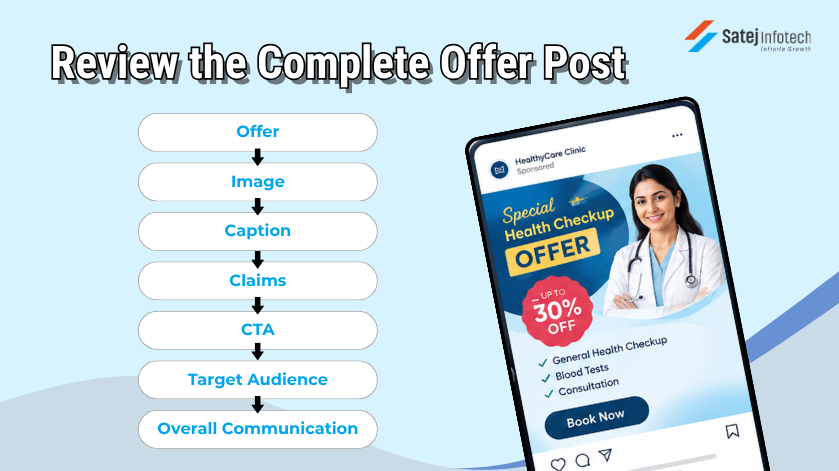
10. Review the Complete Advertisement
🔍 This Is the Final Check.
Don’t look only at the discount.
Review:
The same fee can be communicated in a factual manner or wrapped inside a highly promotional campaign.
The complete communication matters.
Ask:
“What is this post asking the patient to think, feel or do?”
That is the message you should review.
Before publishing social media content, also review our NMC-Safe Posting Checklist for a broader content-safety review.
If your offer post includes patient photographs or before-and-after images, review our Before & After Content Checklist for Doctors and Patient Photo Posting Checklist before publishing.
The Quick Doctor Offer Check
Before publishing an offer-related post, use this simple framework.
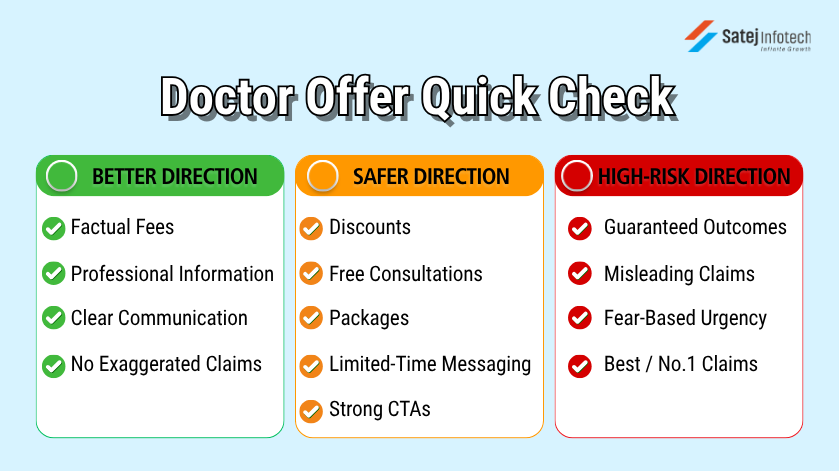
🟢 SAFER DIRECTION
Factual Fees
↓
Professional Information
↓
Clear Communication
↓
No Exaggerated Claims
🟠 STOP & REVIEW
Discounts
Free Consultations
Packages
Limited-Time Messaging
Strong CTAs
These aren’t automatically a conclusion that the content is prohibited.
They are signals that you should review the purpose and presentation carefully against the applicable professional requirements.
🔴 HIGH-RISK DIRECTION
Guaranteed Outcomes
Misleading Claims
Fear-Based Urgency
“Best / No.1” Claims
Product-Style Promotional Language
The One Question to Ask Before You Post
Before publishing an offer, don’t ask only:
“Can I give a discount?”
Ask:
“How am I communicating it?”
Because there is a difference between providing factual professional information and creating a sales-style campaign around medical services.
The Key Takeaway
Healthcare marketing isn’t the same as selling a retail product.
If you are communicating fees, consultations or initiatives online, review the purpose, wording, urgency, claims and CTA together.
Your goal should be to communicate clearly without creating:
- Unrealistic expectations
- Unnecessary pressure
- Misleading claims
- Fear-based urgency
- A commercial impression that compromises professional communication
Inform clearly. Avoid exaggeration. Don’t turn medical outcomes into sales promises.
Want More Practical Marketing Guidance for Doctors?
At Doctor Growth System by Satej Infotech, we help doctors build their digital presence with a practical, patient-focused approach.
Our services include:
- Social Media Strategy
- Doctor Branding
- Content Planning
- Local SEO
- Google Business Profile Optimization
- Healthcare Website Development
- Patient-focused Digital Marketing
Want a FREE 15 Min Marketing Audit for Your Practice?
Click the WhatsApp button below. 💬 Message “FREE 15 min Marketing Audit” on WhatsAppFrequently Asked Questions
The appropriateness of promoting a discount depends on the applicable professional requirements and how the communication is presented. A factual communication about fees is different from a sales-style promotion designed to create urgency and attract patients.
A free consultation should be reviewed in its full context. Consider whether "free" is being communicated as factual information or being used primarily as a promotional hook to generate patient enquiries.
Doctors may communicate factual professional information such as fees, but the presentation should be reviewed to ensure it does not become misleading, exaggerated, or unnecessarily promotional.
"Limited slots" creates urgency. Doctors should consider whether the statement is genuinely necessary and factually accurate or whether it is being used primarily to pressure prospective patients into acting quickly.
Treatment packages should be reviewed carefully against the applicable professional-conduct and advertising requirements. The way the package is presented is important, particularly where it resembles a commercial sales promotion.
Discount-based treatment messaging should be evaluated in its complete context, including the wording, design, CTA and purpose of the communication. Avoid combining an offer with misleading treatment claims or guarantees.
Doctors should avoid combining promotional offers with absolute or guaranteed treatment-outcome claims such as "100% success." An offer does not make an outcome claim safer.
Informing focuses on factual professional information such as fees, qualifications, services or clinic details. Promotion can involve sales-style language, urgency, incentives, exaggerated claims or messaging designed primarily to persuade someone to choose the practice.